
THE COMPLETE PRODUCT GUIDE
HDPE Self-Adhesive Waterproofing Membrane
Pre-applied waterproofing for below-ground concrete structures. Review the product build-up, thickness options and performance data, then consult the installation guidance for your jointing method.
Product overview
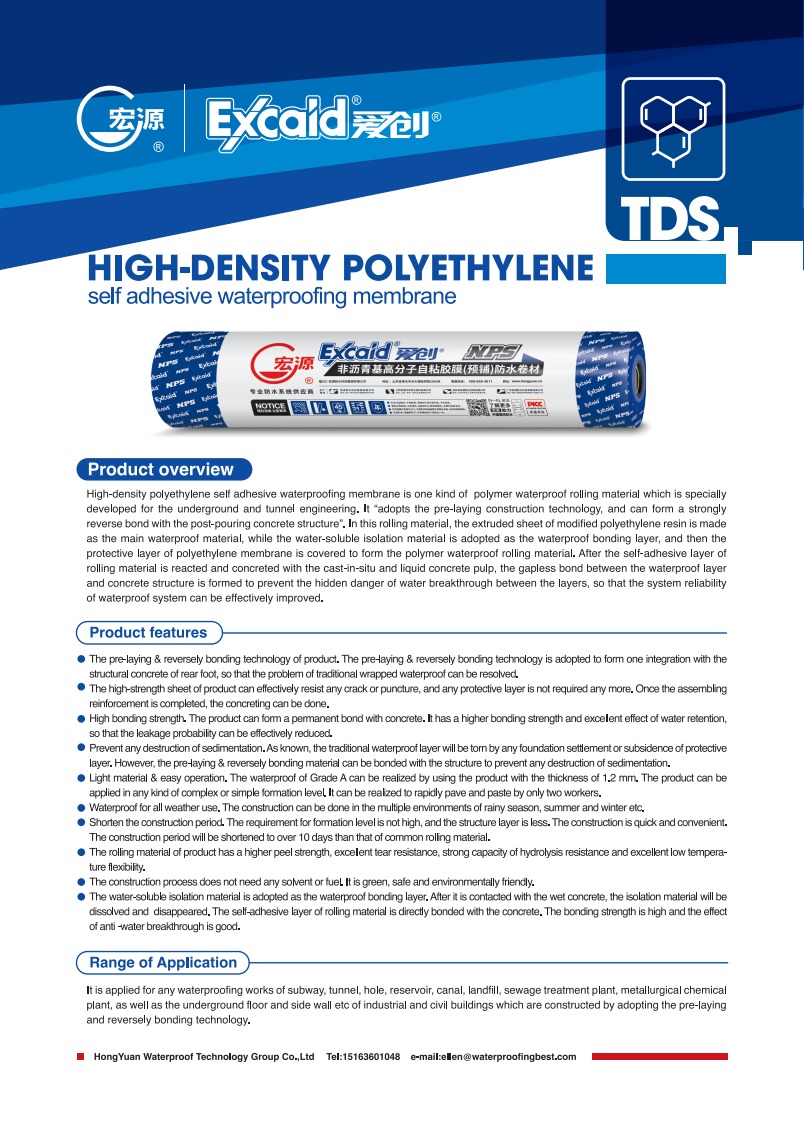
A composite waterproofing membrane developed for underground and tunnel works. A modified HDPE sheet provides the primary water barrier, while the hot-melt adhesive and surface separation layers enable bonding to freshly placed concrete.
The membrane is laid before the concrete pour, with its bonding face towards the structure. The supplied description identifies a water-soluble separation layer that dissolves on contact with wet concrete, allowing the adhesive layer to form the bond.
Key benefits
- Bonded waterproofing: the connection to the structural concrete helps limit lateral water migration at the interface.
- Mechanical resistance: HDPE provides tensile strength and puncture resistance for below-ground construction.
- Low-temperature flexibility: the product sheet reports −25°C flexibility across its listed configurations.
- Pre-applied construction: the source describes direct reinforcement placement without a separate protective screed, subject to the approved build-up and protection during follow-on work.
Performance at a glance
- Composite thickness
- 1.2 / 1.5 / 1.7 mm
- HDPE sheet thickness
- 0.75 / 0.8 / 0.9 / 1.2 mm
- Tensile strength
- 21 or 25 N/mm²
- Elongation at break
- 400% or 500%
- Peel adhesion to concrete
- ≥ 880 (unit to confirm) / ≥ 1500 N/m
- Colour
- White / light grey
Values vary by configuration. The two 1.2 mm options use different bare-film thicknesses and performance values; see the full table for the correct combination.
Typical applications
Below-ground slabs and side walls of industrial and other buildings, subways and tunnels. Reservoirs, canals and other uses listed in the source require project-specific suitability confirmation.
Pre-applied HDPE membrane
MATERIAL & BONDING
How the membrane is built
The supplied description identifies a modified high-density polyethylene sheet as the main waterproofing layer, combined with an adhesive layer and a water-soluble surface separation layer. The membrane is placed before the concrete pour, with the bonding face towards the fresh concrete.
The sheet describes the surface separation layer as dissolving on contact with wet concrete, allowing the adhesive layer to bond to the structure. This is distinct from the method used to connect adjacent membrane sheets.
Bond to the structure
The pre-applied system is designed to stay bonded to the concrete, helping limit lateral water migration and reduce dependence on the supporting substrate.
Mechanical performance
The supplied description highlights puncture resistance, elongation, tear resistance, hydrolysis resistance and low-temperature flexibility. Quantified properties are listed in the table below.
Reinforcement placement
The source describes reinforcement placement without a separate protective screed. Confirm the approved build-up and protect the membrane from damage during follow-on work.
Installation planning
Lightweight sheet handling and fewer construction layers may simplify work. Actual crew size, construction time and weather suitability depend on the project and site conditions.
Installation requirements and any claimed construction benefits depend on the approved system and project conditions. Confirm the adhesive jointing method with the technical team before installation.
TECHNICAL PERFORMANCE
Product specifications
On a small screen, swipe the table horizontally to compare all configurations.
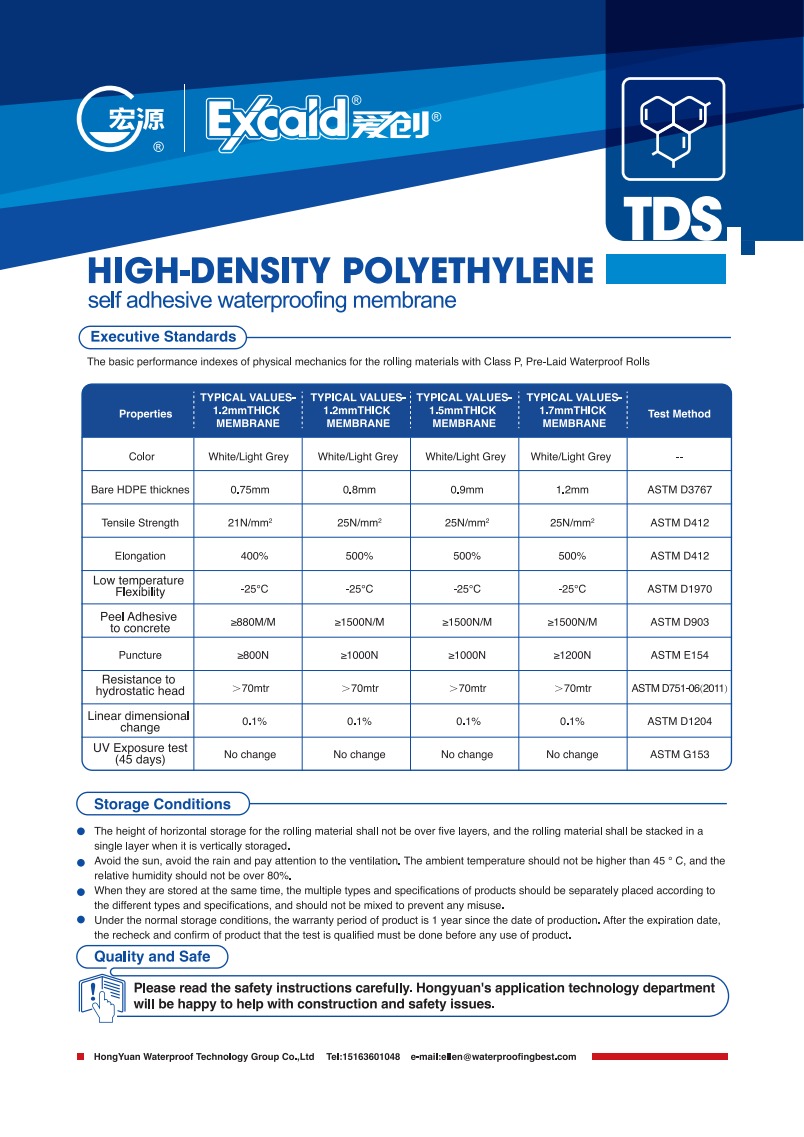
| Property | 1.2 mm Configuration 1 | 1.2 mm Configuration 2 | 1.5 mm | 1.7 mm | Test method¹ |
|---|---|---|---|---|---|
| Colour | White / light grey | White / light grey | White / light grey | White / light grey | — |
| HDPE sheet thickness | 0.75 mm | 0.8 mm | 0.9 mm | 1.2 mm | ASTM D3767 |
| Tensile strength | 21 N/mm² | 25 N/mm² | 25 N/mm² | 25 N/mm² | ASTM D412 |
| Elongation at break | 400% | 500% | 500% | 500% | ASTM D412 |
| Low-temperature flexibility | −25°C | −25°C | −25°C | −25°C | ASTM D1970 |
| Peel adhesion to concrete | ≥ 880 (unit to confirm) | ≥ 1500 N/m | ≥ 1500 N/m | ≥ 1500 N/m | ASTM D903 |
| Puncture resistance | ≥ 800 N | ≥ 1000 N | ≥ 1000 N | ≥ 1200 N | ASTM E154 |
| Resistance to hydrostatic head | > 70 m | > 70 m | > 70 m | > 70 m | ASTM D751-06 (2011) |
| Linear dimensional change | 0.1% | 0.1% | 0.1% | 0.1% | ASTM D1204 |
| UV exposure test (45 days) | No change | No change | No change | No change | ASTM G153 |
¹ Values and test references are transcribed from the supplied product sheet. Referenced editions are reproduced as supplied, not presented as current certification. Confirm test reports and project acceptance criteria before specification. Low-temperature flexibility is a material property, not an installation temperature.
The two 1.2 mm columns are distinct configurations in the supplied sheet; “Configuration 1” and “Configuration 2” are reference labels, not product model names. The source categorises the membrane as Class P pre-applied waterproofing membranes without identifying the corresponding classification standard. The 45-day UV result describes the reported test only and does not establish suitability for permanently exposed roofing. The unit printed for the first configuration’s peel adhesion value is unclear in the source; confirm the unit against the test report before using that value. Hydrostatic-head results should also be checked against the supporting report.
View the original adhesive product pages +
The complete supplied pages are reproduced below for reference. Where the original wording is unclear or conflicting, use the review notes in this guide and request confirmation before use.
LET’S TALK ABOUT YOUR PROJECT
Let’s discuss your project or OEM range.
Share your application, target specification and site conditions, or tell us about the membrane range you want to offer under your own brand.